
Design VS Cigar industry – Part 2.
The Impact of Industrial Design on the Cigar Industry
4. Enhancing the Smoking Experience through Accessories
Ιndustrial design has significantly influenced and in many cases revolutionized the evolution of cigar accessories. Simple utilitarian tools have now become essential accessories of cigar smokers, helping and enhancing the cigar enjoyment experience.
Cigar cutters, cigar ashtrays and cigar holders, humidors and several other accessories have upgraded the overall experience to a ritual of devotion and love. Their manufacturing perfection and performance, combined with the aesthetic approach and functionality, highlight the experience of enjoying a cigar.
1. Cigar Cutters
From simple guillotine cutting tools, cigar cutters have evolved into ergonomic and functional precision mechanical tools. They are made of high quality materials that improve the quality of the cigar cut by offering the user a clean cut - to prevent the cigar from unrolling - providing a necessary and useful function.
Embossed handles, safety locks or a double blade system highlight the design evolution of the cigar cutter.
Evolution points and Patents
The evolution of the cigar cutter developed along with the rise in popularity of cigars in the 18th and 19th centuries, although its evolution cannot be attributed to a single inventor. Many craftsmen and manufacturers improved its function and its acceptance and demand prompted many to develop its design function, ergonomics and aesthetics.
The first designs concerned simple guillotines or punch cutters, while today we have a wide range of proposals such as guillotine, punch, V cutters with many variations in designs, function and aesthetic approach highlighting the style and history of the family that cultivates and produces cigars.

In the early 20th century J. L. Obermayer, a New York inventor, filed on November 13 of 1906 his designs and was granted patent number 835,912 for the double blade cigar cutter.
This double blade mechanism – compared to previous single cutters – was a revolutionary approach and patent because it provided a more precise and clean cut, reducing the risk of crushing the cigar.
This design greatly influenced its development and design and many modern manufacturers have built on and advanced the new standards based on this logic.
During the 20th and 21st centuries many craftsmen and manufacturers with their own additions and patents improved the design, ergonomics and functionality of the cigar cutter - We mention some of them below:
Nov 18, 1906, Inventor: Joseph L. Obermayer - United States, New York - Double Cigar cutter - Current Assignee: Individual

May 18, 1909 – Inventor: Henrie Glauss - United States – Pocket Cigar Scissors
Current Assignee: Individual

June 6,1916 - Inventor: F.W. Davis – United States/Buffalo, New York – Cigar cutter
Current Assignee: Individual

Feb 12, 1991 – Inventor: Xavier Rousseau, Paris, France – Cigar cutter
Current Assignee: ST Dupont SA
Assigned to ST Dupont SA

Aug 17, 1999 – Inventor: Kurt Van Keppel - Scott Almsberger - United States - Cigar cutter
Current Assignee: Xikar INC.
Assigned to Xikar INC.

Dec 26, 2000 – Inventor: Clemens T. Schad - Aesch, Switzerland – Cigar cutter
Assigned to Davidoff & Cie, SA, Geneve, Switzerland

May 07, 2009 – Inventor: Andrew Smith, Pascoag, RI, United States - Cigar Cutting apparatus
Assigned to Colibri Corporation, East Providence, RI

May 10, 2011 – Inventor: Alberto Gutman, United States, Miami FL – Scissor Cigar cutter
Current Assignee: Nicaragua Tobacco Imports Inc.

July 03, 2018 – Inventor: Scott Almsberger, Robert Lembke, Greg Lorett, Kurt Van Keppel -
Current Assignee: Quality Importers Trading Company, LLC
Assigned to Xikar INC.

2. Lighters
The history of the cigar lighter is a small world in the innovation of engineering and design. By combining chemistry, metallurgy, design and aesthetics this object, in addition to its utility, has turned into a symbol of elegance, dynamism and luxury.
The evolution of social customs upgraded its role and it became very much combined with the culture of cigars. It has become a practical, necessary and integral accessory where it is technologically, designally and aesthetically upgraded every day.
Contemporary lighters with their features have evolved into luxury gadgets of ergonomics and functionality. From butane torch lighters with a single, double or triple flame to gas ones whose flame is controlled, the cigar lighter continues to surprise with its evolution.
Notable Inventors and Companies in Lighter History
Johann Döbereiner (Germany, 1823) – Invented the first hydrogen lighter.
Carl Auer von Welsbach (Austria, 1903) – Invented ferrocerium, crucial for spark-based ignition.
George G. Blaisdell (USA, 1932) – Invented the Zippo windproof lighter.
Ronson (USA/UK, early 20th century) – Pioneered the automatic pocket lighter.
Α. The first Lighter
The first real lighter was invented by the German chemist Johann Wolfgang Döbereiner in 1823.
It was called Döbereiner's lamp and the combination of hydrogen gas and a platinum catalyst created ignition.
A zinc vessel made up the bulb and contained sulfuric acid which when reacted with the zinc released hydrogen gas which passed over a platinum sponge catalysing its combustion.

Although it was a large and cumbersome device, it was the principle of ignition with chemicals as the main component. It was a necessary tool widely used in workshops and luxury homes providing an easy and reliable source of continuous flame that did not need friction.
By the end of the 19th century Döbereiner's discovery was improved by many inventors and new ideas and the development of the original idea sparked the need for new and reliable portable lighters.
Β. Carl Auer von Welsbach and Ferrocerium (1903)
A very important development occurred in 1903 when the Austrian scientist Carl Auer von Welsbach
discovered ferrocerium. A synthetic pyrophoric alloy that was very easy to ignite and after frequent use was durable and revolutionized lightweight lighter technology. An innovation still used today in many lighters and survival fire tools.
C. Ronson – Pioneering Automatic Lighters (1910s–1920s)
Ronson, a successful American company that developed with its innovations commercial and quite successful developments and laid the foundations for many of its models, a new aesthetic and a functional design that evolved the demands of an affluent market.

Its first models used brass, chrome and other metals and their design was refined and special.

In 1913, the company produced the "Pist-O-Liter" and in 1926 it released the lighter
"Banjo", an automatic lighter that was the first with the ability to turn on and off with a single push.
E. Zippo – The Iconic Windproof Lighter (1932)
A truly iconic company that has become a true symbol of times and events is the Zippo Manufacturing Company.
Founded by George G. Blaisdell in 1932. Inspired by an Austrian lighter Blaisdell designed a windproof operating system using wick ignition, flint, a perforated chimney to protect the flame and a lid that closed when the flame extinguished.

An innovative, simple and intelligent system developed aesthetically in many designs, identifying with the choices of materials and graphic designs eras and states of cultural becoming.
During the Second World War it reflected American resilience since its operation was robust and easily refillable in particularly difficult conditions.
The characteristic "click", the noise made by the lid when it opened and closed, became famous and known all over the world. In many films and commercials this particular function became a cultural symbol, a move that is considered special and synonymous to this day.
3. Cigar ashtrays & cigar holders
Origins of Ashtrays
- Ancient Roots: The original idea of collecting the ashes in some form of container – even for smokers of pipes or other forms of tobacco – can be found in many cultures many years ago. Cups have been found carved in stone or wood with indentations for the collection of ashes.
- 19th Century: With the increase in the production of cigars in the 1800s and after, there was a need to produce special containers - cigar ashtrays - which began to appear in homes, clubs and public places.
Specific Development of Cigar Ashtray - Designed Differently: They have a different approach to their design with larger grooves around their perimeter so that the cigar can stand in a horizontal position, be stable and not tilt and fall into the ashtray (when the cigar tilts, falls and constantly touches the ashtray it does not keep burning and goes out).
Its design shape and form developed and changed in the late 19th and early 20th centuries. At the same time, its aesthetic approach changed radically, through the materials, the ergonomics and their functionality. - Materials & Makers: Materials such as ceramic, glass, brass, silver or wood were the first ashtrays made and leading companies such as Wedgwood, Tiffany & Co, Dunhill, ST. Dupont, Davidoff and many others as well as Murano glassmakers developed high quality cigar ashtrays in the early and mid 20th century.
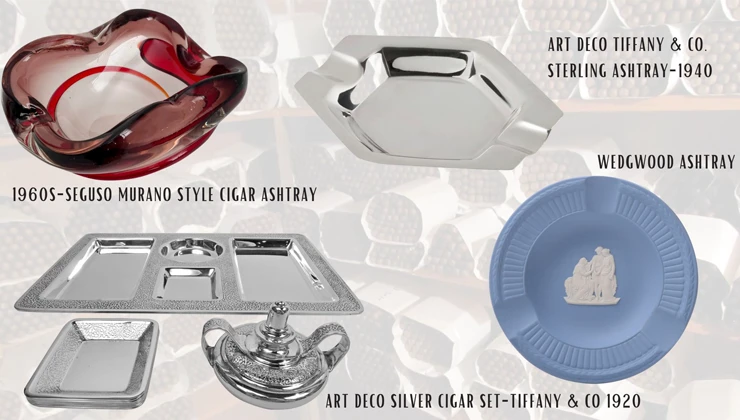
Art Deco and Mid-century designers have developed special and remarkable designs of cigar ashtrays.

Patents & Innovations: There is no particular designer who can claim the invention of cigar ashtrays, but there are important designers and companies who have developed and improved the aesthetics, functionality and ergonomics of these items.
"At the same time, the influential contribution of large families that produce cigars in the industry, evolved the cigar ashtray into another level of aesthetics, luxury and design. Many of them were released as collectibles or numbered, having a catalytic effect on the visibility of its concept, turning them into objects of worship and a high level of symbolism".
Notable Cigar Ashtray Designers and manufactures
Below we list some cigar ashtray designers and manufacturers - past and present - who developed and evolved this utilitarian object into a symbol of high aesthetics, luxury and craftsmanship.
- Karl Hagenauer (Αυστρία, 1898–1956) : Art Deco and special designs with sculptural forms of brass and bronze. They are best classified as mid-century art collectibles.
- Walter Von Nessen (USA, 1902–1943): Modernist inspired by the Bauhaus. He presented the metal ashtrays as office accessories, giving the interior of the houses in the 1930s-1940s, the clean industrial design combined with functionality.
- Russel Wright (USA, 1904–1976): Organic modernism with elegant and simple sculptural designs in wood and ceramic. He significantly influenced the democratization of modern design in mid-20th century America.

- René Lalique (France, 1860–1945): High art of glass and crystal. While focusing more on designing perfume bottles and vases, Lalique created luxurious, elegant glass ashtrays that are now considered high-end collectibles.
- Wolfgang & Pola Hoffmann: A consort with an important place in American modernist design. They designed improved pewter ashtrays and smoking accessories in the 1930s, emphasizing the aesthetics of the machine age.

- Nelson Alfonso: is a well known Cuban artist, packaging designer, and cigar aficionado known for mixing art, tobacco, and luxury in his designs and creations.
Born in Havana in 1965, Alfonso is a trained graphic designer and ceramist who later became an influential figure in both fine arts and premium cigar packaging. He is the founder of Golden Age, a design agency specializing in tobacco branding and design elements. Over his career, he’s designed and crafted packaging and accessories for Habanos S.A. brands like Cohiba Behike, Montecristo, Partagás, Romeo y Julieta, and H. Upmann.

- Oettinger Davidoff AG: a Swiss family production unit in the world of high-quality cigars— a large company with faith in its traditional roots, widely known for high quality in its production process at all levels of its core departments (product and cigars) with a central ambition of continued sustainable development.
It meticulously combines agricultural and production practices with luxury branding and global reach.
It is considered top in cigar accessories, due to its production, with the main focus on luxury, precision and ergonomic functionality.
- Elie Bleu (France): It is a famous French luxury brand, widely known for its accessories and iconic ashtrays. They are made in Limoges-France from high quality porcelain and are knowned for their unparalleled and meticulous craftsmanship with vibrant designs.
Collections such as the Medal Collection, Flor de Alba, Egoist Cigar Ashtray – Cuba Flag, Limited Edition Dragon Ashtray and many others reflect the rich cultural heritage by deepening through excellence an enduring commitment to creating small works of art.

- S.T. Dupont (France): It is a famous French luxury brand, widely known for its accessories, especially lighters, pens, leather goods and luxury gifts, high-tech items with an elegant and minimalist design.
Founded in 1872 by Simon Tissot-Dupont, the company originally made leather briefcases and travel cases for the elite clients.
It is known for its high and precise craftsmanship (handmade production) but also for its Chinese lacquer techniques and metalworking techniques.
Famous customers used her products such as Winston Churchill, Audrey Hepburn, Pablo Picasso and Queen Elizabeth II.
The cigar ashtray uses materials such as palladium and lacquer with a simple, elegant and minimal design.
Dunhill: British luxury brand particularly known for its elegant handmade cigar accessories and leather goods. It was founded in 1893 by Alfred Dunhill in London.
Notable Cigar Accessories
- Rollagas lighter– One of Dunhill's iconic butane gas lighters, known for reliability and stylish design.
- Unique Lighter – A vintage petrol lighter with ignition system on the side wheel, collectible and sought after.
Iconic Humidors, cigar cutters & leather cigar cases, porcelain, crystal or silver cigar ashtrays, accessories with understated minimal British elegance for cigar lovers looking for refined design and vintage luxury.

Hermès: A luxury French fashion house known for its leather goods, lifestyle accessories, perfumery and iconic Birkin and Kelly bags.
It occasionally produces refined porcelain cigar ashtrays in limited edition designs

4. Humidors
The history of the cigar humidor is a reflection of all the new changes in a wide field in technology, taste and culture.
From its humble beginnings as a simple wooden container the humidifier has evolved into something bigger than just a container.
It began as a necessity for cigar preservation and has grown and evolved into a dynamic and diverse industry that follows and is being shaped by global trends and personal passions.
A high-tech storage and preservation solution that expresses lifestyle, art, identity.
It protects and preserves so that every cigar we enjoy - as its creator wishes - is rich in taste, aroma and character.
It is not just a maintenance tool but a symbol of dedication to the cigar lover, a symbol of elegance, perfection and tradition for the finer things in life, in a world that is constantly changing rapidly.
A story of evolution, high craftsmanship, passion and true worship.
To be continued (Part 3.)
Important Notice
"This article features names, historical events, external links and additional references about the impact of industrial design on the cigar industry (Design VS Cigar industry – Part 2.)
If any of the prominent figures mentioned in this article do not wish to be included, please contact via email
Edited by Marios Krokos
Industrial designer